
The optical distribution network (ODN) is the passive part of an FTTH network: the feeder, distribution and drop cables, splitters, closures and boxes between the OLT in the central office and the ONU in each home. It is also where most of the build cost and most of the delay sit. Two approaches dominate today: the traditional spliced ODN and the pre-connected Quick ODN.
How a traditional ODN is built
In a traditional ODN, fibers are joined on site. At every closure, cabinet and distribution point a technician prepares the cable, fusion-splices each fiber and seals the joint in a splice closure.
- Extensive splicing at multiple points along every route.
- Skilled technicians and specialised, costly tools such as fusion splicers and OTDRs on every crew.
- Complex, time-consuming work that depends on weather, site access and individual workmanship.
What changes with Quick ODN
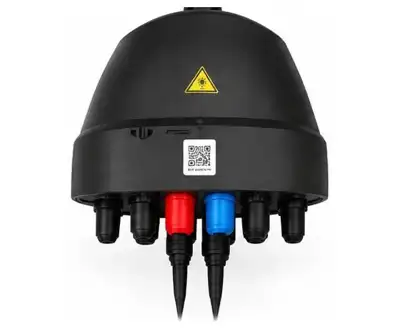
Quick ODN moves that work into the factory. Hub, sub and end boxes arrive with splitters installed, and cables arrive pre-terminated with hardened QuickConnect SC/APC connectors. On site, crews mount the boxes and plug the cables together, with no field splicing in the distribution and drop network.
- Faster installation: plug-and-play connections speed up on-site deployment.
- Fewer errors: every connection is 100% factory-tested for consistent quality.
- Lower labour cost: simpler builds need fewer skilled splicing hours.
- Easier maintenance: a faulty drop is unplugged and replaced instead of re-spliced.
Side-by-side comparison
| Traditional ODN | Quick ODN | |
|---|---|---|
| Joining method | Fusion splicing on site | Factory pre-connected, plug-and-play |
| Crew skills | Skilled splicing technicians | General installers |
| Tools on site | Fusion splicer, cleaver, OTDR | Mounting tools; OTDR for acceptance |
| Quality | Depends on each technician and conditions | 100% factory-tested connections |
| Deployment speed | Slow and weather-dependent | Fast, predictable |
| Total cost of ownership | Baseline | Around 15% lower |
Cascaded design with unequal splitting
Kakluk Quick ODN uses a cascaded design. A single fiber runs from box to box; at each sub box an unequal PLC splitter sends most of the light on down the chain and a small share to the local drop ports. A typical 1×9 sub box passes 70% onward and feeds 8 subscribers with the other 30%. The chain ends at an end box with an equal 1×4, 1×8 or 1×16 splitter.
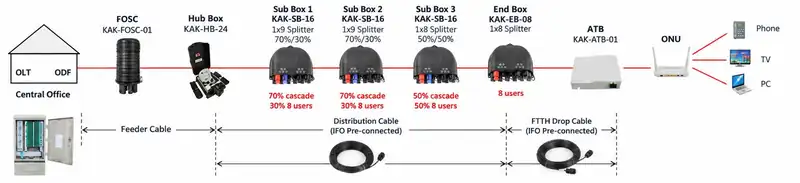
- Low density (villas, single-family areas): 4-port sub boxes with 1×5 splitters, up to 7 boxes per chain.
- Medium density (townhouses): 8-port sub boxes with 1×9 splitters and a 1×8 end box.
- High density (apartment blocks, business districts): 16-port sub boxes with 1×17 splitters and a 1×16 end box.
One PON port supports 32 subscribers without a hub splitter, or 64 with a 1:2 splitter in the hub box.
When each approach fits
A traditional ODN still makes sense for very large central-office terminations and for routes where every fiber count must be customised on site. Quick ODN is the better choice when speed, predictable quality and labour cost decide the project: greenfield residential estates, rural and village roll-outs, and operators or contractors building thousands of homes passed with limited splicing crews.
Talk to Kakluk about your network
Kakluk supplies the complete Quick ODN family: hub, sub and end boxes, steel-tube PLC splitters, pre-connected distribution and drop cables, fittings and cable storage. Browse the FTTx Quick ODN products, see the matching GPON OLT and ONU equipment, or contact our engineers for a network design and quote.